In a departure from the usual Happiness column, I feel compelled to share eight comments that real people have actually said that they may not realize are truly horrible. Some may read it and say, "But Valerie... I've said that and I'm not a horrible person." Maybe you aren't right now, but at the moment those words came out of your mouth, you were. You were horrible. Sorry, that's just a fact.
This is by no means a definitive list. I'm sure you have a few of your own to add. Feel free.
1. "She's wonderful. She's not like other black people at all."
This was said often by my great uncle, who had exactly one black employee, which he thought made him not a racist. Any time you "compliment" someone for not being like other members of their race, you're a horrible person. Variations include complimenting someone for being good at some everyday thing that you think is beyond their abilities (like being articulate or a good driver), or assuming someone is good at something like basketball or math or getting the best deal on new carpeting because of their skin color or background. You only add to your horribleness when you say, "It's okay for me to say this because my best friend is [insert race here]." Keep it safe and just assess people as individuals, based on their demonstrated behavior. Anything more, and you risk being horrible.
2. "Wow, you used to be so beautiful!"
I've heard this one twice. Once, when a colleague brought her bridal album in to show another woman some wedding ideas and it became clear that she had gotten married about 90 pounds ago, and once on Facebook, when a friend posted a picture from her youth, and another friend wrote it. The latter got a private note from me, and quickly changed her post to what she should have said in the first place: "Wow, you are so beautiful!"
People change. They age. They get fat. Reminding someone that they are no longer as physically attractive as they once were is mean. And unnecessary. And it makes you a horrible person. Which brings us to the runner up in this category: "You have such a pretty face, if you would just lose weight." Yep. Horrible person. Next time, put a period after the word face.
3. "My sister-in-law was in labor for 18 hours and the cord was wrapped around her son's neck, and he was born severely brain damaged. He was perfectly healthy up until then."
This was said to my friend when she was 7.5 months pregnant. With a boy. She burst into tears.
What is it about seeing a pregnant woman that makes people feel the need to share their harrowing labor/birth defect/stillborn stories? If you see a woman who is clearly about to produce life from her loins, happiness and sunshine better come out of your mouth, or just keep it shut.
4. "My friend did IVF for six years and as soon as they stopped trying, she got pregnant."
I swear, when you are going through IVF, everyone in the world happens to know someone who got pregnant just by giving up. That baby is about as real as the offspring of the Loch Ness monster and Bigfoot. Every physical act is part of the "trying" process, whether one will admit it or not, so it's cruel and painful to tell someone to stop trying. For every unique snowflake who gets pregnant naturally after $30,000 spent on fertility treatments, there are a thousand heartbroken potential parents who are not at all comforted by your fairy tale. They're in pain and you're making it worse.
Close runner up: "Maybe this is for the best. Don't you think you're too old to have a baby?" This was said to me by a family member one week after I miscarried my daughter, after four years and $30,000 spent trying and "not trying."
Also, don't ever ask an infertile couple if they've considered adoption. Do you really think that had never crossed their minds until you suggested it? Nothing will come of asking that other than an even more painful conversation.
Stick with, "I really wish you guys the best of luck." That's all there is to say.
5. "Did you try to have children of your own?"
I could write an entire post about the idiotic things people say to adoptive parents, often in front of their children, particularly if those children are a different race. For a mother, her adopted child is a "child of her own," and her journey to motherhood is none of your damn business. Instead, bust out with, "What a beautiful family! I'm so happy for all of you."
6a. "All that kid needs is a smack on the ass."
6b. "It is disgusting that people medicate their children instead of just parenting them."
I am embarrassed to admit, these are things I've said in the past. Repeatedly. Before I knew better. It's so easy to pass judgment on parents and children without knowing all the facts, but that excuse doesn't make me any less horrible for having said those things and others like them.
My cousin's son has a mental illness. These comments are just a small sampling of things that have been said to her, sometimes in front of him. They are mean-spirited, disparaging, ignorant and heartbreaking. From the outside, we have no idea what kind of parent someone is or what their child's special needs might be, so it's best to pipe down. Making a comment isn't making the world a better place. Next time, smile and try, "It's the hardest job in the world. Is there anything I can do to help?"
(Speaking of children with different needs and abilities - if a small person in a costume comes to your house on Thursday night and doesn't make eye contact or can't manage to say, "Trick or treat," be a decent human being and happily give them the candy without making a big deal out of it. Their beleaguered parents will be eternally grateful.)
7. "That medicine is poison. It actually causes cancer."
This gem was said to a dear friend of mine who was put on Prednisone for her severe allergies, after countless doctors and several years of nothing else working. Way to go, horrible person with no medical training whatsoever! Your eight words caused an extremely ill woman to spend two hours on the phone crying to me, in sheer panic and desperation.
A close runner up in the illness category is, "You don't look sick," usually said in an accusatory or suspicious tone, since the speaker clearly has X-ray vision and can medically scan a total stranger's internal organs. Need something to say in the face of illness? Best option is, "I'm so sorry you're still not feeling well. Do you need any help?"
8. "Everything happens for a reason."
I understand. Someone has passed and you feel the need to say something to the loved ones, but you don't need to be original or special. No one is waiting for your witty bon mots. Stick with what is 100-percent safe: "I am so sorry for your loss. You and your family are in my thoughts. Please let me know if there is anything I can do."
Follow that with silence. Silence is your friend. It's okay to just quietly be there for someone when they need to cry, or yell, or fall apart, without pouring fuel on it by saying something potentially hurtful.
When I was a junior in high school, my best friend died of a brain tumor. I will never forget standing next to her mother at the funeral, hearing person after person say to her, "Everything happens for a reason."
Each time, she had to grit her teeth and resist the urge to slug them in the jaw. For a parent who has lost a child, there is absolutely no freaking reason. Keep that thought to yourself.
Also, if someone else's religious beliefs don't jibe with yours, the death of their loved one is not the time to make that clear. And if you are using the death of someone's child to evangelize about your religion to them, then you are a horrible person and whatever God you believe in is pissed that you're doing it in his name.
We have an obligation on this planet not to make life more sucky than it already is for anyone else, so take a fearless self-inventory and choose your words more carefully next time. Every time.
Ask yourself if what you're about to say will benefit anyone other than you, and if the answer is, "no," swallow those words and find a way to be as loving and harmless as possible. Do your best not to be horrible. That will make the world a much happier place.
For a guidebook in achieving lasting, permanent happiness, check out "Happiness as a Second Language" currently the #1 Happiness book on Amazon, on sale in October for just $0.99! For added fun, watch The Happiest Book Trailer Ever. And for even more happiness, please visit Speak Happiness, and follow Speak Happiness on Facebook and Twitter.
For more by Valerie Alexander on Huffington Post, click here.
For more on happiness, click here.
Thursday, October 31, 2013

Wednesday, October 30, 2013
5 Holiday Lifestyle Lessons We Can Learn From the Shutdown Debacle
No matter which side of the political divide you identify with, we have all been frustrated by recent antics in Washington. But, believe it or not, there are a lot of similarities between factors that led to the recent government shutdown and our own holiday season lifestyle behaviors. So there may be a few lessons we can all learn from Congress, especially with holiday season just around the corner.
Embrace moderation instead of extremes.
Recent congressional standoffs epitomize taking extreme actions. Similarly, most of us adopt extreme lifestyle behaviors throughout holiday season. Halloween marks the start of eating season, and soon after those tasty treats first emerge, the season becomes focused on revelry and rich food.
But there is another side to holiday season, one that usually begins after the effects of New Year festivities have worn off -- the focus on shedding those extra holiday pounds. Gallup polls show that more than half of all Americans every year want to lose weight, and they spend over 60 billion dollars on weight-loss products every year, with much of that spending occurring in the first quarter of every year.
Just like extreme political positions cost the economy billions of dollars, these extreme indulgences before and extreme dieting or exercise regimens after are both financially costly and damage our bodies. Starving yourself in January is about as healthy as shutting down the government due to lack of moderate compromise.
Act now, instead of kicking the can down the road.
The resolution to the partisan standoff in Washington was to defer decision making until January 2014. This sounds familiar, politically and personally. Most people find it difficult to make healthy choices during the holiday season. It's just so much easier to put it off until tomorrow, or until January 2. As Dr. Harvey Fineberg of the Institute of Medicine writes in The Journal of the American Medical Association, "Success of prevention is invisible, lacks drama, often requires persistent behavior change." This is possibly why we avoid the hard decisions now and try to repent for our indulgences after.
But much like Washington's regular absurdities have led to repeated embarrassments and economic losses, cyclical bingeing and repenting results in bodily hurt. Studies have shown that repeated sugar, salt and fatty-food binges deteriorate our bodies' ability to cope with normal doses of food, and eventually, diabetes, blood pressure and cholesterol problems emerge.
So instead of post-season resolutions, perhaps people should adopt pre-season resolutions. Behavior specialists have shown that mental preparation and dedication to lifestyle goals can help sustain healthy behaviors in the long term. Even the best of us have to plan ahead to fit in that run, or think about what lunch will look like the next day to avoid resorting to the convenient and often unhealthy options. So make that resolution now and stick to it.
Pick the right issue to address.
The political battles that led to the shutdown were about health care financing and the size of government. However, if Congress had asked common Americans what they care about, it would have found that jobs and economic well-being are our leading concerns. The shutdown actually had negative economic effects on government employees and businesses that depend on local spending or government services, and as a result, Congress' approval ratings have plunged.
Similarly, during and after holiday season, we are all overly obsessed with numbers on a weighing scale. Our lifestyle choices -- what we eat, our level of physical activity, tobacco use, and yes, even weight -- are powerful risk factors for diabetes and heart disease, which are the most costly, disabling and fatal diseases nationally. However, there is more to this story. Even people who aren't overweight get diabetes and heart disease, suggesting that factors other than weight are involved, like stress or smoking. Also, weight increases or decreases aren't immediate and usually occur after a lag. So weighing oneself over the season is not a great way of monitoring oneself. This also means, by the way, that it's still bad to indulge excessively, even though the weighing scale shows no change the day after!
Weight is also an imperfect measure of one's lifestyle: healthy lifestyles (more exercise, more wholesome diets) can lower diabetes risk without any weight loss. This may be because exercise and healthier diets lower the amount of fat in one's body and replace it with lean muscle, so one's weight might not change at all. Also, healthy lifestyle changes improve how efficiently the body manages the sugar and cholesterol we put in. And exercise has psychological benefits, both from the body's physiological response and from having a set amount of time away from work and life pressures.
Weight does matter, just like health care financing matters to Americans. Excess weight leads to many ailments -- joint troubles, poor wound healing, reproductive problems and even cancers. Clearly, moderate and sustained weight loss among people who are overweight will be of benefit. It's just that weight should not be the sole barometer of our efforts to be healthy. Though weight lost or gained is easier to monitor than calories consumed and miles run, our lifestyle choices themselves can be monitored, and once people know what to look for, healthy choices can become routine and a more accurate depiction of wellness.
Lead by example.
Voting in Washington tends to follow political and social alliances. Studies have shown that caucus voting behavior and lifestyle choices are similar in this regard. Social influences can shape one's likelihood of using tobacco or of being obese. So, don't just follow the pack in holiday season. Have the courage to continue to be active and make healthy choices. Leading by example may have trickle-down effects and encourage other family and friends to make and stick to their pre-season resolutions.
Strong leadership and having the courage to vote outside of party lines could have averted the shutdown and near financial collapse. Have courage and be a role model for friends and family, this (and every) holiday season.
Don't be powerless.
At times, it feels like we are at the mercy of Congress' whims. But, let's not forget that we are the constituents they are supposed to represent, and we have the power to vote for change every two years.
Similarly, although our environments are not always conducive to healthy behaviors, we aren't powerless, either. Yes, we need macro-level changes to make neighborhoods safer and increase access to healthier foods, but it's also possible to find solutions that fit our circumstances. There are increasingly community-based organizations (like the Y of USA) delivering lifestyle-change programs; more and more employers are offering wellness benefits and opportunities to attract and retain the most talented employees -- agencies like the American Heart Association, American Diabetes Association, and Centers for Disease Control and Prevention regularly produce freely available health-and-wellness guidelines based on the best evidence (look out for their emblems); and there are more online tools and gadgets to help us decipher food and exercise quality and quantity than ever before.
In summary, to avoid our own personal January 2 shutdowns, let's learn from Congress' transgressions. Let's be moderate, aim for pre-emptive physical and psychological wellness, and lead by example in both our voting and holiday season behaviors.
For more by Dr. Mohammed K. Ali, click here.
For more on diet and nutrition, click here.
Embrace moderation instead of extremes.
Recent congressional standoffs epitomize taking extreme actions. Similarly, most of us adopt extreme lifestyle behaviors throughout holiday season. Halloween marks the start of eating season, and soon after those tasty treats first emerge, the season becomes focused on revelry and rich food.
But there is another side to holiday season, one that usually begins after the effects of New Year festivities have worn off -- the focus on shedding those extra holiday pounds. Gallup polls show that more than half of all Americans every year want to lose weight, and they spend over 60 billion dollars on weight-loss products every year, with much of that spending occurring in the first quarter of every year.
Just like extreme political positions cost the economy billions of dollars, these extreme indulgences before and extreme dieting or exercise regimens after are both financially costly and damage our bodies. Starving yourself in January is about as healthy as shutting down the government due to lack of moderate compromise.
Act now, instead of kicking the can down the road.
The resolution to the partisan standoff in Washington was to defer decision making until January 2014. This sounds familiar, politically and personally. Most people find it difficult to make healthy choices during the holiday season. It's just so much easier to put it off until tomorrow, or until January 2. As Dr. Harvey Fineberg of the Institute of Medicine writes in The Journal of the American Medical Association, "Success of prevention is invisible, lacks drama, often requires persistent behavior change." This is possibly why we avoid the hard decisions now and try to repent for our indulgences after.
But much like Washington's regular absurdities have led to repeated embarrassments and economic losses, cyclical bingeing and repenting results in bodily hurt. Studies have shown that repeated sugar, salt and fatty-food binges deteriorate our bodies' ability to cope with normal doses of food, and eventually, diabetes, blood pressure and cholesterol problems emerge.
So instead of post-season resolutions, perhaps people should adopt pre-season resolutions. Behavior specialists have shown that mental preparation and dedication to lifestyle goals can help sustain healthy behaviors in the long term. Even the best of us have to plan ahead to fit in that run, or think about what lunch will look like the next day to avoid resorting to the convenient and often unhealthy options. So make that resolution now and stick to it.
Pick the right issue to address.
The political battles that led to the shutdown were about health care financing and the size of government. However, if Congress had asked common Americans what they care about, it would have found that jobs and economic well-being are our leading concerns. The shutdown actually had negative economic effects on government employees and businesses that depend on local spending or government services, and as a result, Congress' approval ratings have plunged.
Similarly, during and after holiday season, we are all overly obsessed with numbers on a weighing scale. Our lifestyle choices -- what we eat, our level of physical activity, tobacco use, and yes, even weight -- are powerful risk factors for diabetes and heart disease, which are the most costly, disabling and fatal diseases nationally. However, there is more to this story. Even people who aren't overweight get diabetes and heart disease, suggesting that factors other than weight are involved, like stress or smoking. Also, weight increases or decreases aren't immediate and usually occur after a lag. So weighing oneself over the season is not a great way of monitoring oneself. This also means, by the way, that it's still bad to indulge excessively, even though the weighing scale shows no change the day after!
Weight is also an imperfect measure of one's lifestyle: healthy lifestyles (more exercise, more wholesome diets) can lower diabetes risk without any weight loss. This may be because exercise and healthier diets lower the amount of fat in one's body and replace it with lean muscle, so one's weight might not change at all. Also, healthy lifestyle changes improve how efficiently the body manages the sugar and cholesterol we put in. And exercise has psychological benefits, both from the body's physiological response and from having a set amount of time away from work and life pressures.
Weight does matter, just like health care financing matters to Americans. Excess weight leads to many ailments -- joint troubles, poor wound healing, reproductive problems and even cancers. Clearly, moderate and sustained weight loss among people who are overweight will be of benefit. It's just that weight should not be the sole barometer of our efforts to be healthy. Though weight lost or gained is easier to monitor than calories consumed and miles run, our lifestyle choices themselves can be monitored, and once people know what to look for, healthy choices can become routine and a more accurate depiction of wellness.
Lead by example.
Voting in Washington tends to follow political and social alliances. Studies have shown that caucus voting behavior and lifestyle choices are similar in this regard. Social influences can shape one's likelihood of using tobacco or of being obese. So, don't just follow the pack in holiday season. Have the courage to continue to be active and make healthy choices. Leading by example may have trickle-down effects and encourage other family and friends to make and stick to their pre-season resolutions.
Strong leadership and having the courage to vote outside of party lines could have averted the shutdown and near financial collapse. Have courage and be a role model for friends and family, this (and every) holiday season.
Don't be powerless.
At times, it feels like we are at the mercy of Congress' whims. But, let's not forget that we are the constituents they are supposed to represent, and we have the power to vote for change every two years.
Similarly, although our environments are not always conducive to healthy behaviors, we aren't powerless, either. Yes, we need macro-level changes to make neighborhoods safer and increase access to healthier foods, but it's also possible to find solutions that fit our circumstances. There are increasingly community-based organizations (like the Y of USA) delivering lifestyle-change programs; more and more employers are offering wellness benefits and opportunities to attract and retain the most talented employees -- agencies like the American Heart Association, American Diabetes Association, and Centers for Disease Control and Prevention regularly produce freely available health-and-wellness guidelines based on the best evidence (look out for their emblems); and there are more online tools and gadgets to help us decipher food and exercise quality and quantity than ever before.
In summary, to avoid our own personal January 2 shutdowns, let's learn from Congress' transgressions. Let's be moderate, aim for pre-emptive physical and psychological wellness, and lead by example in both our voting and holiday season behaviors.
For more by Dr. Mohammed K. Ali, click here.
For more on diet and nutrition, click here.
Tuesday, October 29, 2013
4 'Healthwashing' Pitfalls to Watch Out For
It is no secret that the food industry is a master of deceptive marketing. Its liberty with the term "natural" (largely due to the Food and Drug Administration's refusal to come up with a strict definition) has been covered extensively, as have countless examples of "healthwashing" that try to pass off highly-processed and minimally-nutritious offerings as wholesome.
This time, I want to bring your attention to the many ways in which Big Food likes to concoct a false perception of "unprocessing" -- and I'm naming names.
1. "Artisan"

Meant to evoke images of a skilled food craftsman preparing small batches of a self-created "secret" recipe, this term is misused and abused by Big Food in a multitude of ways. Apart from the fact that most fast food "artisan" offerings (like Wendy's artisan egg breakfast sandwich) are mass-produced, frozen, and then reheated in a microwave or convection oven, there is also a legal issue at stake. Last year, New York City-based bagel company Davidovich Bakery sued Dunkin' Donuts for deceptively co-opting the term.
Often times, the ingredients in Big Food "artisan" products are your standard hyper-processed atrocity. Consider Pillsbury's "Artisan Pizza Crust":
Nothing says "artisan" like bleached flour, trans fats and artificial flavors!
2. "Multigrain"

Remember: The only thing multigrain means is that a food product contains more than one type of grain. In other words, a cracker made with three different highly-refined, fiberless grains is technically a multigrain cracker. "Multigrain" has nothing to do with health. Consider, for instance, multigrain Pringles - the epitome of eye-rolling healthwashing.
Here's the ingredient list for the "original" multigrain variety:
And here you have classic (non-multigrain) Pringles ingredient list:
In essence, multigrain Pringles contain more corn flour than dried potatoes, a sprinkling of oat and malted barley flours, a pinch of wheat bran, and dried black beans.
The Nutrition Facts labels, meanwhile, are practically mirror images:
Calories: 150 (Classic) vs. 140 (Multigrain)
Sodium: 160 milligrams (Classic) vs. 150 milligrams (Multigrain)
Fiber: 1 gram (Classic) vs. 1 gram (Multigrain)
And take a look at Dunkin' Donuts multigrain flatbread, used in its breakfast sandwiches:
The first ingredient is white flour, and this flatbread is made with azodicarbonamide, a dough conditioner banned in Australia and the European Union (the United Kingdom being the exception).
Ignore "multigrain" claims and instead head straight to the ingredient list to get past the hype.
3. "Stoneground"

This one is complicated.
For starters, some of the health benefits of stoneground flour -- that is, flour made from grains that are solely ground in stone mills -- are up for debate. The stone-milling process does retain more of the fiber-rich bran (even in white flour), but claims that stoneground flour retains more vitamins and minerals than conventionally-milled flour (made on roller mills) due to lower-temperature processing have not been confirmed by studies.
Even if your choice of seeking stoneground flour is less about nutritional properties and more about respecting a traditional processing technique, you still have your work cut out for you. The Food & Drug Administration (FDA) has not drafted a legal definition of "stoneground," so many food companies use this term when they use grains that only go through a stone mill once and then go through the conventional milling process.
When in doubt, call the company and ask. Reputable companies that truly produce 100 percent stoneground flour -- like Bob's Red Mill -- will be more than happy to share those details with you. If, however, you see "stoneground flour" on a box of highly-processed crackers, approach with skepticism.
4. "Made With Real..."

The food industry loves using "made with real..." claims to give the illusion of a true-to-nature product ("See, we aren't deceptive! We aren't 'cheese-flavored,' we use real cheese.") and get consumers' guards down.
The front of the package for Cheez-It Colby crackers includes a "made with real cheese" call out. Yes, these crackers contain real cheese... along with omega-6 loaded (and likely GMO) soybean oil, the artificial and petroleum-derived preservative TBHQ, artificial flavors, and two artificial dyes.
Then there's General Mills-owned Betty Crocker cheddar and bacon casserole boxed potatoes. "Made With 100 percent Real Potatoes!" is prominently featured on the box. Alas, the ingredient list also reveals imitation bacon bits made from partially hydrogenated oils, artificial flavoring, and red food dye #40 as well as modified (GMO) corn starch, hydrolyzed soy protein, and artificial colors yellow 5 and 6 lake.
Similarly, Kellogg's NutriGrain bars' packaging includes a "made with real fruit" stamp on the front. However, the raspberry filling in these bars contains raspberry purée concentrate -- as the third ingredient (it's overpowered by invert sugar and corn syrup).
Truly unprocessed food doesn't need to toot its own horn with meaningless call outs and claims, nor is it composed of a litany of ingredients, including artificial flavoring and neon-bright dyes. Above all, remember: The front of a product's packaging is pure marketing -- ingredient lists tell the true tale.
This post originally appeared in Eating Rules.
This time, I want to bring your attention to the many ways in which Big Food likes to concoct a false perception of "unprocessing" -- and I'm naming names.
1. "Artisan"
Meant to evoke images of a skilled food craftsman preparing small batches of a self-created "secret" recipe, this term is misused and abused by Big Food in a multitude of ways. Apart from the fact that most fast food "artisan" offerings (like Wendy's artisan egg breakfast sandwich) are mass-produced, frozen, and then reheated in a microwave or convection oven, there is also a legal issue at stake. Last year, New York City-based bagel company Davidovich Bakery sued Dunkin' Donuts for deceptively co-opting the term.
Often times, the ingredients in Big Food "artisan" products are your standard hyper-processed atrocity. Consider Pillsbury's "Artisan Pizza Crust":
Whole Wheat Flour Bleached, Enriched Flour Bleached (wheat flour, niacin, ferrous sulfate, thiamin mononitrate, riboflavin, folic acid), Water, Soybean Oil. Contains 2% or less of: Vital Wheat Gluten, Dextrose, Sugar, Leavening (glucono delta-lactone, baking soda), Salt, Partially Hydrogenated Cottonseed Oil, Natural and Artificial Flavor, Mono and Diglycerides, Xanthan Gum, Yeast, Autolyzed Yeast Extract, Azodicarbonamide (dough conditioner), Enzyme.
Nothing says "artisan" like bleached flour, trans fats and artificial flavors!
2. "Multigrain"
Remember: The only thing multigrain means is that a food product contains more than one type of grain. In other words, a cracker made with three different highly-refined, fiberless grains is technically a multigrain cracker. "Multigrain" has nothing to do with health. Consider, for instance, multigrain Pringles - the epitome of eye-rolling healthwashing.
Here's the ingredient list for the "original" multigrain variety:
Corn flour, vegetable oil (contains one or more of the following: corn oil, cottonseed oil, soybean oil, and/or sunflower oil), dried potatoes, rice flour, maltodextrin, wheat starch, modified rice starch, sugar, mono- and di-glycerides, oat flour, malted barley flour, wheat bran, salt, dried black beans, caramel color and annatto extract (color).
And here you have classic (non-multigrain) Pringles ingredient list:
Dried potatoes, vegetable oil (contains one or more of the following: corn oil, cottonseed oil, soybean oil, and/or sunflower oil), rice flour, wheat starch, maltodextrin, salt and dextrose.
In essence, multigrain Pringles contain more corn flour than dried potatoes, a sprinkling of oat and malted barley flours, a pinch of wheat bran, and dried black beans.
The Nutrition Facts labels, meanwhile, are practically mirror images:
Calories: 150 (Classic) vs. 140 (Multigrain)
Sodium: 160 milligrams (Classic) vs. 150 milligrams (Multigrain)
Fiber: 1 gram (Classic) vs. 1 gram (Multigrain)
And take a look at Dunkin' Donuts multigrain flatbread, used in its breakfast sandwiches:
Enriched Wheat Flour [Wheat Flour, Malted Barley Flour, Niacin, Reduced Iron, Thiamine Mononitrate (Vitamin B1), Riboflavin (Vitamin B2), Folic Acid], Water, Grains (Whole Wheat Flour, Oat Flour, Yellow Corn Flour, Rye Flour, Buckwheat Flour, Rice Flour, Spelt Flour, Toasted Sesame Seeds, Millet, Flax Seeds, Poppy Seeds, Sugar), Soybean Oil, Yeast, Contains 2 percent or less of: Salt, Cracked Whole Wheat, Baking Powder (Sodium Bicarbonate, Sodium Acid Pyrophosphate, Monocalcium Phosphate), Nonfat Dry Milk, Dough Conditioner (Calcium Sulfate, Guar Gum, Vegetable Mono and Diglycerides, L-Cysteine, Calcium Peroxide, Enzymes), Yeast Nutrients (Ammonium Sulfate, Ascorbic Acid, Azodicarbonamide), Calcium Propionate and Potassium Sorbate (Preservatives)
The first ingredient is white flour, and this flatbread is made with azodicarbonamide, a dough conditioner banned in Australia and the European Union (the United Kingdom being the exception).
Ignore "multigrain" claims and instead head straight to the ingredient list to get past the hype.
3. "Stoneground"
This one is complicated.
For starters, some of the health benefits of stoneground flour -- that is, flour made from grains that are solely ground in stone mills -- are up for debate. The stone-milling process does retain more of the fiber-rich bran (even in white flour), but claims that stoneground flour retains more vitamins and minerals than conventionally-milled flour (made on roller mills) due to lower-temperature processing have not been confirmed by studies.
Even if your choice of seeking stoneground flour is less about nutritional properties and more about respecting a traditional processing technique, you still have your work cut out for you. The Food & Drug Administration (FDA) has not drafted a legal definition of "stoneground," so many food companies use this term when they use grains that only go through a stone mill once and then go through the conventional milling process.
When in doubt, call the company and ask. Reputable companies that truly produce 100 percent stoneground flour -- like Bob's Red Mill -- will be more than happy to share those details with you. If, however, you see "stoneground flour" on a box of highly-processed crackers, approach with skepticism.
4. "Made With Real..."
The food industry loves using "made with real..." claims to give the illusion of a true-to-nature product ("See, we aren't deceptive! We aren't 'cheese-flavored,' we use real cheese.") and get consumers' guards down.
The front of the package for Cheez-It Colby crackers includes a "made with real cheese" call out. Yes, these crackers contain real cheese... along with omega-6 loaded (and likely GMO) soybean oil, the artificial and petroleum-derived preservative TBHQ, artificial flavors, and two artificial dyes.
Then there's General Mills-owned Betty Crocker cheddar and bacon casserole boxed potatoes. "Made With 100 percent Real Potatoes!" is prominently featured on the box. Alas, the ingredient list also reveals imitation bacon bits made from partially hydrogenated oils, artificial flavoring, and red food dye #40 as well as modified (GMO) corn starch, hydrolyzed soy protein, and artificial colors yellow 5 and 6 lake.
Similarly, Kellogg's NutriGrain bars' packaging includes a "made with real fruit" stamp on the front. However, the raspberry filling in these bars contains raspberry purée concentrate -- as the third ingredient (it's overpowered by invert sugar and corn syrup).
Truly unprocessed food doesn't need to toot its own horn with meaningless call outs and claims, nor is it composed of a litany of ingredients, including artificial flavoring and neon-bright dyes. Above all, remember: The front of a product's packaging is pure marketing -- ingredient lists tell the true tale.
This post originally appeared in Eating Rules.
Postcards From Lebanon: Part 10 in a Series of Cancer-Related Commentary
"Fly me to the moon..." (Bart Howard)
Previously I had reported that I had tried to get a prescription -- approval -- for medical marijuana. My oncologist was willing, but since cannabis had only recently been approved for medical purposes in New Hampshire, there was no process in place; and I've now learned there will most likely not be a process in place in New Hampshire until early 2015.
Imagine my dilemma upon hearing and reading that cannabis helps with chemotherapy side-effects (therapeutic uses of cannabis). With wrecked taste buds, forever feeling nauseous, having pain from the Neulasta shot, chemo brain, and generally exhausted from the chemo drugs, I longed for something to help.
Some of the taste bud side-effects from chemotherapy include a) sensitivity, for example, to metal utensils; b) sedated, for instance, to spices; and c) shuffled, i.e., your favorite meal may taste awful. And this only serves to exacerbate the nausea. Of course, these reactions are individualized to each of us, and may not happen, as we pass through the chemo haze.
And yet, depending upon how ones taste buds react, some people choose to switch from metal to plastic utensils; others don't eat their favorite foods so they won't have the bad memory when chemotherapy is over; worse yet, some don't eat. As for nausea, you will be given medicine during chemo and pills to take while at home -- these drugs have their own side-effects that are intestinal in nature, and are also to be avoided when possible.
Not wanting to eat, intestinal issues, pain, exhaustion and chemo brain were becoming my norm. But then I got a call from a nurse at my Primary Care Physician's (PCP) office as a follow-up to my six days in the hospital when my white blood cells evaporated (see Part 5). Not one to be bashful, I asked if my PCP would prescribe/approve my receiving medical marijuana to help with my cancer treatments. And thus began the "best part" of having to be treated for cancer (reminds me of when I was told I had cancer that if I had to have leukemia I had the "best kind"). There is no "best part" or "best kind."
This wonderful nurse provided me with the Vermont website from which I could pre-print the required Application Form -- Registered Patient/Marijuana Registry. Of course, I would have felt a lot better had the site not been part of the Vermont Criminal Information Center website.
This same nurse also set up an appointment with my PCP even though I had asked if we could handle this over the phone since my oncologist warned me against going places where there would be sick people -- a doctor's office is typically one of those places. Since I had no choice, I met with my PCP and had a physical in order to comply with one of the many Vermont requirements.
I received from my PCP a signed and completed Health Care Professional Verification Form, which was to be submitted with my Application Form. In addition to filling out both forms, my patient Application Form had to be notarized; I was required to provide a digital picture of myself, and a check for $50 completed my package, which was sent to the Marijuana Registry, Department of Public Safety, Waterbury, Vermont.
Two weeks and two days later I received my plastic, photo ID and thought I was ready to play among the stars. Instead, I found included information on the three "planned" dispensaries in Vermont. I now needed to register for one of the dispensaries by filling out and returning the designated dispensary form along with my ID; it will be the only dispensary from which I'll be allowed to purchase cannabis (see Marijuana Dispensary Information for the state of Vermont; as of August 2013 there were 711 people registered). I chose the one in Brandon, VT (Rutland County Organics).
Per Vermont state law, instead of buying cannabis through a dispensary, I could have chosen to grow my own, but I had no idea how long that would take. Also, there are limits to the number of plants, number of mature plants, where it can be grown, etc. To my way of thinking there were too many requirements making it too easy to run afoul of the law.
Once I had my plastic, photo ID with named dispensary, I made an appointment (walk-ins are not accepted; check and cash only). I was driven to the site north of Brandon, Vermont, and had a 30 minute meeting where we discussed the different strains available (sativa for day, indica for night, and hybrid for anytime), and the various formats in which the cannabis could be purchased (weighted flower buds, edibles, clones/plants).
I purchased one gram of six different varieties so I could see which one(s) worked best for me. I paid a slight discount (the price of weed has skyrocketed since I was in college in the early '70s), plus tax, and left with the cannabis securely in a lock-box (another Vermont state requirement) I had purchased that morning. I don't smoke the marijuana, but use a propane-fired, hand-held vaporizer -- provided by one of my angels -- which heats the cannabis to a temperature whereby it is turned into a vapor that can easily be taken into the lungs.
My experience is as follows (again, please note that these are individualized effects where your response may be different):

Note: The naming convention is rather common, but there will be variations from dispensaries given there is no standardization or government control yet in place.
Although it is still illegal on the federal level, the state in which I live, Vermont, has decriminalized it and allows its growth and distribution. Also, Vermont politicians are reaching out to retired law enforcement officers (Law Enforcement Against Prohibition -- LEAP) to help with legalization. And according to a recent Gallup poll, more Americans than ever favor legalization: 58 percent to 39 percent. Also, the U.S. Senate Judiciary Committee is beginning hearings to address the conflicts between federal and state laws. You can find the status in your state, any fees associated with registering, the possession limit, dispensary locations, and whether or not your state accepts other states' registry ID at Medical Marijuana.
You may also find the following of interest:
• "Cannabis Rx: Cutting Through the Misinformation," by Dr Andrew Weil [click here]
• "What If Cannabis Cured Cancer," by Len Richmond [click here]
• "Marijuana Compounds Can Kill Some [Leukemia] Cancer Cells: Study," by Matt Ferner [click here]
• "Science for potheads: Why they love to get high," by K.M. Cholewa [click here]
I don't know if cannabis will work wonders for everyone, but it has contributed to my improvement this cycle: I have started gaining weight, I'm no longer feeling even mildly depressed, and my reaction (pain, low-grade-fever, fatigue) to the Neulasta shot was of a shorter duration this cycle. I do still have chemo brain, which means it takes me longer to write these blogs because it's hard to remember or think of things, and my focus and attention to detail are limited. But what a difference...
Timing: 4-Nov through 7-Nov: Cycle Four (4) of chemotherapy.
Oh, and Chip Beehler, Andria Donohue, Doreen Bolger, Meredith Bullock and Alex Ford have been added to my list of angels here on earth.
Fly me to the moon...
Postcards From Lebanon: Part 1
Postcards From Lebanon: Part 2
Postcards From Lebanon: Part 3
Postcards From Lebanon: Part 4
Postcards From Lebanon: Part 5
Postcards From Lebanon: Part 6
Postcards From Lebanon: Part 7
Postcards From Lebanon: Part 8
Postcards From Lebanon: Part 9
Previously I had reported that I had tried to get a prescription -- approval -- for medical marijuana. My oncologist was willing, but since cannabis had only recently been approved for medical purposes in New Hampshire, there was no process in place; and I've now learned there will most likely not be a process in place in New Hampshire until early 2015.
Imagine my dilemma upon hearing and reading that cannabis helps with chemotherapy side-effects (therapeutic uses of cannabis). With wrecked taste buds, forever feeling nauseous, having pain from the Neulasta shot, chemo brain, and generally exhausted from the chemo drugs, I longed for something to help.
Some of the taste bud side-effects from chemotherapy include a) sensitivity, for example, to metal utensils; b) sedated, for instance, to spices; and c) shuffled, i.e., your favorite meal may taste awful. And this only serves to exacerbate the nausea. Of course, these reactions are individualized to each of us, and may not happen, as we pass through the chemo haze.
And yet, depending upon how ones taste buds react, some people choose to switch from metal to plastic utensils; others don't eat their favorite foods so they won't have the bad memory when chemotherapy is over; worse yet, some don't eat. As for nausea, you will be given medicine during chemo and pills to take while at home -- these drugs have their own side-effects that are intestinal in nature, and are also to be avoided when possible.
Not wanting to eat, intestinal issues, pain, exhaustion and chemo brain were becoming my norm. But then I got a call from a nurse at my Primary Care Physician's (PCP) office as a follow-up to my six days in the hospital when my white blood cells evaporated (see Part 5). Not one to be bashful, I asked if my PCP would prescribe/approve my receiving medical marijuana to help with my cancer treatments. And thus began the "best part" of having to be treated for cancer (reminds me of when I was told I had cancer that if I had to have leukemia I had the "best kind"). There is no "best part" or "best kind."
This wonderful nurse provided me with the Vermont website from which I could pre-print the required Application Form -- Registered Patient/Marijuana Registry. Of course, I would have felt a lot better had the site not been part of the Vermont Criminal Information Center website.
This same nurse also set up an appointment with my PCP even though I had asked if we could handle this over the phone since my oncologist warned me against going places where there would be sick people -- a doctor's office is typically one of those places. Since I had no choice, I met with my PCP and had a physical in order to comply with one of the many Vermont requirements.
I received from my PCP a signed and completed Health Care Professional Verification Form, which was to be submitted with my Application Form. In addition to filling out both forms, my patient Application Form had to be notarized; I was required to provide a digital picture of myself, and a check for $50 completed my package, which was sent to the Marijuana Registry, Department of Public Safety, Waterbury, Vermont.
Two weeks and two days later I received my plastic, photo ID and thought I was ready to play among the stars. Instead, I found included information on the three "planned" dispensaries in Vermont. I now needed to register for one of the dispensaries by filling out and returning the designated dispensary form along with my ID; it will be the only dispensary from which I'll be allowed to purchase cannabis (see Marijuana Dispensary Information for the state of Vermont; as of August 2013 there were 711 people registered). I chose the one in Brandon, VT (Rutland County Organics).
Per Vermont state law, instead of buying cannabis through a dispensary, I could have chosen to grow my own, but I had no idea how long that would take. Also, there are limits to the number of plants, number of mature plants, where it can be grown, etc. To my way of thinking there were too many requirements making it too easy to run afoul of the law.
Once I had my plastic, photo ID with named dispensary, I made an appointment (walk-ins are not accepted; check and cash only). I was driven to the site north of Brandon, Vermont, and had a 30 minute meeting where we discussed the different strains available (sativa for day, indica for night, and hybrid for anytime), and the various formats in which the cannabis could be purchased (weighted flower buds, edibles, clones/plants).
I purchased one gram of six different varieties so I could see which one(s) worked best for me. I paid a slight discount (the price of weed has skyrocketed since I was in college in the early '70s), plus tax, and left with the cannabis securely in a lock-box (another Vermont state requirement) I had purchased that morning. I don't smoke the marijuana, but use a propane-fired, hand-held vaporizer -- provided by one of my angels -- which heats the cannabis to a temperature whereby it is turned into a vapor that can easily be taken into the lungs.
My experience is as follows (again, please note that these are individualized effects where your response may be different):
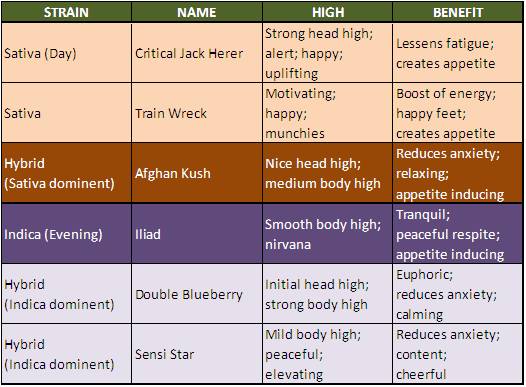
Note: The naming convention is rather common, but there will be variations from dispensaries given there is no standardization or government control yet in place.
Although it is still illegal on the federal level, the state in which I live, Vermont, has decriminalized it and allows its growth and distribution. Also, Vermont politicians are reaching out to retired law enforcement officers (Law Enforcement Against Prohibition -- LEAP) to help with legalization. And according to a recent Gallup poll, more Americans than ever favor legalization: 58 percent to 39 percent. Also, the U.S. Senate Judiciary Committee is beginning hearings to address the conflicts between federal and state laws. You can find the status in your state, any fees associated with registering, the possession limit, dispensary locations, and whether or not your state accepts other states' registry ID at Medical Marijuana.
You may also find the following of interest:
• "Cannabis Rx: Cutting Through the Misinformation," by Dr Andrew Weil [click here]
• "What If Cannabis Cured Cancer," by Len Richmond [click here]
• "Marijuana Compounds Can Kill Some [Leukemia] Cancer Cells: Study," by Matt Ferner [click here]
• "Science for potheads: Why they love to get high," by K.M. Cholewa [click here]
I don't know if cannabis will work wonders for everyone, but it has contributed to my improvement this cycle: I have started gaining weight, I'm no longer feeling even mildly depressed, and my reaction (pain, low-grade-fever, fatigue) to the Neulasta shot was of a shorter duration this cycle. I do still have chemo brain, which means it takes me longer to write these blogs because it's hard to remember or think of things, and my focus and attention to detail are limited. But what a difference...
Timing: 4-Nov through 7-Nov: Cycle Four (4) of chemotherapy.
Oh, and Chip Beehler, Andria Donohue, Doreen Bolger, Meredith Bullock and Alex Ford have been added to my list of angels here on earth.
Fly me to the moon...
Postcards From Lebanon: Part 1
Postcards From Lebanon: Part 2
Postcards From Lebanon: Part 3
Postcards From Lebanon: Part 4
Postcards From Lebanon: Part 5
Postcards From Lebanon: Part 6
Postcards From Lebanon: Part 7
Postcards From Lebanon: Part 8
Postcards From Lebanon: Part 9
Monday, October 28, 2013
8 Messages to Teach Young Women and Girls About Happiness
Women's happiness levels have been on the decline for the past few decades, so says a 2009 study entitled, "The Paradox of Declining Female Happiness." If that is the case, what are young women and girls learning about what it means to be happy? Who are their happiness role models? It wasn't until I burned out after seven years of practicing law that I gave much thought to my own happiness. If you could give some advice to young women and girls about how to build happiness, what would you say? Here is my list, which is based on my own personal experiences, what gets my clients stuck, and the research.
Maxing out isn't healthy. Many young women want to go to a good college, get a good job, find a good relationship, and be good moms. When leaning in turns into burning out, though, women experience serious health, relationship, and emotional consequences that aren't easily fixed. Rather than focusing on "having it all," let's ask young women what they want and help them define success on their own terms.
Buy more experiences and less stuff. When I was a teenager, I wanted to have the same cool clothes as my friend's sister -- she had all of the name brand stuff and I thought she was so cool. When I graduated from law school and started practicing, it was nice to be able to afford a trendy new handbag here and there. Having stuff isn't bad, but materialism is. Not only does materialism not bring happiness, it's a strong predictor of unhappiness. One study examined the attitudes of 12,000 freshman when they were 18, then measured their life satisfaction at age 37. Those who had expressed materialistic aspirations as freshmen were less satisfied with their lives two decades later (Nickerson, Schwartz, Diener, & Kahneman, 2003). My husband and I don't live in a big house and my car is almost 10 years old, and that is by design. Living below our means allowed me to start my own business when my law career ended and it allows us to travel -- experiences that have changed my life far more than a new car.
Focus on self-efficacy rather than self-esteem. Self-esteem is the evaluation of your own self worth, while self-efficacy is your ability to feel like you can produce results in your own life. When I first heard psychologist Dr. Karen Reivich talk about the differences between the two, I was convinced that self-efficacy is the more important focus. When young women and girls get an "A" or a trophy for simply showing up, they are robbed of the ability to learn how to adjust and deal with failure. Unfortunately, we've overshot the mark in trying to protect our kids from this evil thing called failure when in reality, failure builds resilience.
Take (good) risks. When you are asked to give a presentation, try out for a team, or do something new, what do you do? Do you shy away or jump in? Would it surprise you to know that when it comes to evaluating ability, men tend to overestimate theirs and women tend to underestimate theirs (Reilly & Mulhern, 1995). Think back to how your 8-year-old self was praised. Dr. Carol Dweck explains that young girls are often praised for being "smart" or "good," while young boys are often praised for "trying hard." As a result, many young girls develop a fixed mindset -- the belief that ability is fixed or static. She avoids challenges, tries to look smart, gives up easily, and sees added effort as fruitless. Meanwhile, young boys tend to develop a growth mindset -- the belief that ability can be developed. He embraces challenges, persists during setbacks, and believes that with more effort, he can master a task. Not all girls have fixed mindsets and not all boys have growth mindsets, but Dr. Dweck's research certainly suggests that the way boys and girls are praised has consequences later in life (Dweck, 2008).
Don't get stuck in your own faulty thinking. When I speak to students and professionals about my own experiences with burnout, I describe myself as a "people pleasing, perfectionist, achieve-aholic." It's my way of illustrating how the faulty assumptions we make and our deep patterns of thinking undercut happiness and resilience and create a lot of stress in our lives. If you catch yourself thinking any of the following, pay attention to what is driving your belief system, and know that the young women and girls in your life are paying attention to how you manage these beliefs:
** What will people think of me?
** I have to be perfect.
** I have to achieve more.
** I can handle it all on my own.
** I can't take time for myself.
Perfection really does not exist. It took me years to realize how destructive the pursuit of perfection really is. Thinking you have to do things perfectly and/or be perfect is like carrying around a heavy weight on your back, and it absolutely crushes creativity. According to research professor Dr. Brene Brown, "Perfection is correlated with depression, anxiety, addiction, and life paralysis or missed opportunities. The fear of failing, making mistakes, not meeting people's expectations, and being criticized keeps us outside of the arena where healthy competition and striving unfolds" (Brown, 2012).
Vulnerability is good. The less I focused on perfection and the more I focused on being vulnerable, the more opportunities unfolded for me. Vulnerability is what helped me stop my law practice, go back to school, and start a new business working with people and on projects I could never have imagined. Don't get me wrong, I HATE being vulnerable and it absolutely does not come easy to me. It's a daily practice, in fact, but the alternative is a life where I'm not fully "all in," and that's just not acceptable to me anymore.
Avoid happiness traps. Many women (myself included) have bought into one or more of these happiness myths at some point in their lives -- I call them the "I'll be happy when's:"
** I'll be happy when I get married or find that great relationship
** I'll be happy when I make more money
** I'll be happy when I have kids
** I'll be happy when I lose weight
** I'll be happy when I change jobs/get a new job/get promoted
Our culture spins a very seductive story for young women, making it seem as though they're not worthy or can't be happy unless and until they've achieved these milestones.
These messages will help young women and girls take control of their happiness, resilience, and health. What would you add?
Paula Davis-Laack, JD, MAPP, is an internationally-published writer and travels the globe as a stress and resilience expert. She has trained thousands of professionals on how to manage their stress and increase their happiness by building a specific set of skills designed to develop personal resilience and prevent burnout. Paula is available for speaking engagements, training workshops, media commentary, and private life coaching - contact her at paula@pauladavislaack.com or visit her website at www.pauladavislaack.com.
Connect with Paula on Twitter, Facebook, and LinkedIn.
References
Brown, B. (2012). Daring greatly. New York: Gotham Books.
Dweck, C. (2008). Mindset: The new psychology of success. New York: Ballentine Books.
Lyubomirsky, S. (2013). The myths of happiness: What should make you happy but doesn't; what shouldn't make you happy but does. New York: The Penguin Press (for a more in-depth look at happiness myths).
Nickerson, C., Schwartz, N., Diener, E., & Kahneman, D. (2003). Zeroing in on the dark side of the American dream: A closer look at the negative consquences of the goal for financial success. Psychological Science, 14, 531-536.
Reilly, J., & Mulhern, G. (1995). Gender differences in self-estimated IQ: The need for care in interpreting group data. Personality and Individual Differences, 18(2), 368-373. See also, Young, V. (2011). The secret thoughts of successful women. New York: Crown Business.
ALSO ON HUFFPOST:
Maxing out isn't healthy. Many young women want to go to a good college, get a good job, find a good relationship, and be good moms. When leaning in turns into burning out, though, women experience serious health, relationship, and emotional consequences that aren't easily fixed. Rather than focusing on "having it all," let's ask young women what they want and help them define success on their own terms.
Buy more experiences and less stuff. When I was a teenager, I wanted to have the same cool clothes as my friend's sister -- she had all of the name brand stuff and I thought she was so cool. When I graduated from law school and started practicing, it was nice to be able to afford a trendy new handbag here and there. Having stuff isn't bad, but materialism is. Not only does materialism not bring happiness, it's a strong predictor of unhappiness. One study examined the attitudes of 12,000 freshman when they were 18, then measured their life satisfaction at age 37. Those who had expressed materialistic aspirations as freshmen were less satisfied with their lives two decades later (Nickerson, Schwartz, Diener, & Kahneman, 2003). My husband and I don't live in a big house and my car is almost 10 years old, and that is by design. Living below our means allowed me to start my own business when my law career ended and it allows us to travel -- experiences that have changed my life far more than a new car.
Focus on self-efficacy rather than self-esteem. Self-esteem is the evaluation of your own self worth, while self-efficacy is your ability to feel like you can produce results in your own life. When I first heard psychologist Dr. Karen Reivich talk about the differences between the two, I was convinced that self-efficacy is the more important focus. When young women and girls get an "A" or a trophy for simply showing up, they are robbed of the ability to learn how to adjust and deal with failure. Unfortunately, we've overshot the mark in trying to protect our kids from this evil thing called failure when in reality, failure builds resilience.
Take (good) risks. When you are asked to give a presentation, try out for a team, or do something new, what do you do? Do you shy away or jump in? Would it surprise you to know that when it comes to evaluating ability, men tend to overestimate theirs and women tend to underestimate theirs (Reilly & Mulhern, 1995). Think back to how your 8-year-old self was praised. Dr. Carol Dweck explains that young girls are often praised for being "smart" or "good," while young boys are often praised for "trying hard." As a result, many young girls develop a fixed mindset -- the belief that ability is fixed or static. She avoids challenges, tries to look smart, gives up easily, and sees added effort as fruitless. Meanwhile, young boys tend to develop a growth mindset -- the belief that ability can be developed. He embraces challenges, persists during setbacks, and believes that with more effort, he can master a task. Not all girls have fixed mindsets and not all boys have growth mindsets, but Dr. Dweck's research certainly suggests that the way boys and girls are praised has consequences later in life (Dweck, 2008).
Don't get stuck in your own faulty thinking. When I speak to students and professionals about my own experiences with burnout, I describe myself as a "people pleasing, perfectionist, achieve-aholic." It's my way of illustrating how the faulty assumptions we make and our deep patterns of thinking undercut happiness and resilience and create a lot of stress in our lives. If you catch yourself thinking any of the following, pay attention to what is driving your belief system, and know that the young women and girls in your life are paying attention to how you manage these beliefs:
** What will people think of me?
** I have to be perfect.
** I have to achieve more.
** I can handle it all on my own.
** I can't take time for myself.
Perfection really does not exist. It took me years to realize how destructive the pursuit of perfection really is. Thinking you have to do things perfectly and/or be perfect is like carrying around a heavy weight on your back, and it absolutely crushes creativity. According to research professor Dr. Brene Brown, "Perfection is correlated with depression, anxiety, addiction, and life paralysis or missed opportunities. The fear of failing, making mistakes, not meeting people's expectations, and being criticized keeps us outside of the arena where healthy competition and striving unfolds" (Brown, 2012).
Vulnerability is good. The less I focused on perfection and the more I focused on being vulnerable, the more opportunities unfolded for me. Vulnerability is what helped me stop my law practice, go back to school, and start a new business working with people and on projects I could never have imagined. Don't get me wrong, I HATE being vulnerable and it absolutely does not come easy to me. It's a daily practice, in fact, but the alternative is a life where I'm not fully "all in," and that's just not acceptable to me anymore.
Avoid happiness traps. Many women (myself included) have bought into one or more of these happiness myths at some point in their lives -- I call them the "I'll be happy when's:"
** I'll be happy when I get married or find that great relationship
** I'll be happy when I make more money
** I'll be happy when I have kids
** I'll be happy when I lose weight
** I'll be happy when I change jobs/get a new job/get promoted
Our culture spins a very seductive story for young women, making it seem as though they're not worthy or can't be happy unless and until they've achieved these milestones.
These messages will help young women and girls take control of their happiness, resilience, and health. What would you add?
Paula Davis-Laack, JD, MAPP, is an internationally-published writer and travels the globe as a stress and resilience expert. She has trained thousands of professionals on how to manage their stress and increase their happiness by building a specific set of skills designed to develop personal resilience and prevent burnout. Paula is available for speaking engagements, training workshops, media commentary, and private life coaching - contact her at paula@pauladavislaack.com or visit her website at www.pauladavislaack.com.
Connect with Paula on Twitter, Facebook, and LinkedIn.
References
Brown, B. (2012). Daring greatly. New York: Gotham Books.
Dweck, C. (2008). Mindset: The new psychology of success. New York: Ballentine Books.
Lyubomirsky, S. (2013). The myths of happiness: What should make you happy but doesn't; what shouldn't make you happy but does. New York: The Penguin Press (for a more in-depth look at happiness myths).
Nickerson, C., Schwartz, N., Diener, E., & Kahneman, D. (2003). Zeroing in on the dark side of the American dream: A closer look at the negative consquences of the goal for financial success. Psychological Science, 14, 531-536.
Reilly, J., & Mulhern, G. (1995). Gender differences in self-estimated IQ: The need for care in interpreting group data. Personality and Individual Differences, 18(2), 368-373. See also, Young, V. (2011). The secret thoughts of successful women. New York: Crown Business.
ALSO ON HUFFPOST:
Sunday, October 27, 2013
How Mindfulness Skills Help Children Flourish in School And in Life
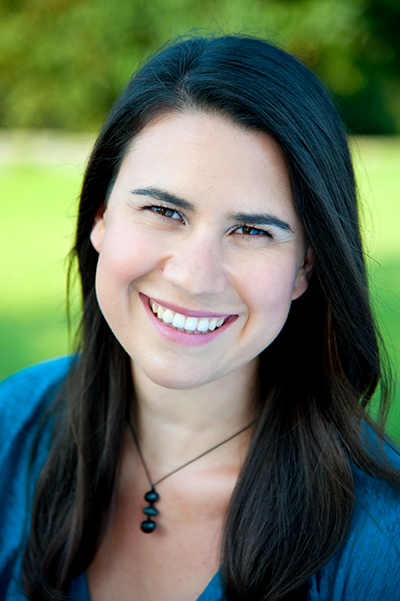 I first met Jennifer Cohen Harper at a Yoga Service Council meeting at the Omega Institute. She is the founder and director of Little Flower Yoga, a national organization based in New York, and The School Yoga Project, which brings yoga and mindfulness to schools nationwide. She is the vice president of the Yoga Service Council and an active member of the International Association of Yoga Therapists. She leads a well-respected children's yoga and mindfulness teacher certification program, provides therapeutic yoga classes to children and families, and frequently collaborates with other organizations to bring yoga and mindfulness to places as diverse as tent cities in Port au Prince, Haiti, Sanctuary for Families in NY, and the Bronx Zoo. Her work has been featured in the NY Times and the International Journal of Yoga Therapy. She is the author of "Little Flower Yoga for Kids: A Yoga and Mindfulness Program to Help Your Child Improve Attention and Emotional Balance." Little Flower Yoga offers yoga and mindfulness to children and teachers in a way that connects meaningfully with their everyday life, and gives them tools to build resilience, make good choices, and find emotional balance.
Rob: What originally motivated you to do this work, and what continues to motivate you? How, if at all, has that motivation changed over time?
My initial motivation came from a sense of gratitude for how yoga helped me during some of the most challenging times in my own life, combined with a desire to be useful. But now sharing yoga is something that draws me closer to other people in a nourishing and personally enriching way. Much of my current motivation is about connection and relationship. Yoga is the framework for sharing a way of living in the world. When I'm fully immersed in this work, I feel like I'm the best version of myself, and my heart is most open. That's a really nice space to live in.
How is yoga effective in improving attention and emotional balance in children?
Often these two challenges are addressed with different approaches, but we know that the capacity to pay attention is directly tied to emotional balance. Kids have to feel good to access the part of themselves that is capable of focus and good decision-making. Yoga improves both of these in a way that is fundamentally appealing to children--through their bodies and through direct experience.
In my work, I emphasize skill building rather then diagnosis and treatment. Kids are freed from the self-doubt that often comes with labeling, while still getting the support they need. Yoga is low-cost, requires little equipment, and has only healthy side effects. Because yoga is a lifelong skill, rather than an intervention, children can build resilience before challenges occur.
What should educators know about yoga and mindfulness practices? Parents?
That the most important thing they can offer children is their own mindfully aware attention. A lot of what kids need in order to pay attention is to feel seen, accepted, and loved. A personal practice can make us more capable of offering this even if we aren't teaching yoga to kids directly.
That being said, sharing yoga with children doesn't have to be intimidating. I wrote my book in the expectation that the reader has no yoga experience. I always encourage personal practice, but don't want adults to feel like they have to be an expert in order to share yoga with kids.
Is there an evidence base for your program in particular?
In developing the program, we relied on existing research about how children develop, learn, grow, and heal. Currently, we're working with a researcher who is evaluating our curriculum and implementation based on data collected from 24 schools and 21 teachers over 18 months. Preliminary results have been positive and we are looking forward to his full report. It's surprising how much an outside perspective can change even the questions you are asking yourself!
What is the greatest challenge you face in bringing therapeutic yoga to children and families?
Five years ago, I might have said it was overcoming institutional skepticism in schools and among parents, but this has changed tremendously. Now, from the perspective of my role at LFY, our toughest barrier is finding enough great teachers! Schools want the programming, but this is hard work. It requires training, practice, preparation, reflection, and a wide variety of skills that aren't always easy to find in one person.
Another major challenge is finding ways to help kids integrate the practices into their lives. It's really important that adults support and reinforce the work. It's heartbreaking to see a child make great strides in class, and then hear about or see him being sort of beaten down by others. This happens easily, and often by well-meaning people. Getting parents and teachers invested in the work, familiar with strategies that make behavior management more compassionate and respectful, and ultimately involved enough to remind the child of tools he has learned during difficult moments, is the ultimate goal.
What are some of your ideas about, or hopes for, the future of "service yoga" in America in the next decade?
My work with the Yoga Service Council has given me a broad perspective on all the good work being done in this field, and a lot of opportunity to reflect on what the possibilities are. I think one important thing to recognize and respond to is that, as yoga becomes more widely accepted, an increasingly diverse body of students will be appearing in all yoga classes, not just specialty classes. I think it's a responsibility of our community to make sure that yoga teacher trainings prepare their graduates to teach in a way that is inclusive, respectful, and sensitive, as you never know who is going to walk into class on any given day.
Also, there is so much potential in empowering people in the helping professions to share the most effective practices directly with their clients, students, and patients. This is already happening in some places. I teach staff development workshops at schools, and even teachers who don't have any yoga experience are amazed at how effective easy-to-teach activities are for their students. Finding balance between longer, more in-depth classes with yoga teachers, and simple daily practice reinforced by those who work most directly and most often with the students or clients is a worthy and achievable goal. The Yoga Service Conference is one place where teachers, social workers, counselors, health care providers, and others can come to learn these tools, and develop their own personal practice. The conference will be offered at the Omega Institute this spring, May 16-18, 2014. I know that each year when I am surrounded by the people the conference draws, the energy is so big yet so focused that I feel certain there is nothing this community can't accomplish in a decade.
Editor: Alice Trembour
Stay connected with Give Back Yoga Foundation as we share the gift of yoga with the world, one person at a time, by following us on Facebook, Twitter and Google+ and by subscribing to our newsletter.
Do you want to bring the transformational power of yoga and meditation to underserved populations? Join Give Back Yoga at the Sedona Yoga Festival in February for a two-day Mindful Therapeutic Yoga Practices for Veterans pre-conference training that offers yoga teachers clinically-proven techniques to help students recover from trauma and emotional stress.
Weekly Meditations for Healthy Sex (Oct. 25-31)
It's vital for mindful acts of emotional and spiritual intimacy to steadily develop as a daily practice for healthy sex. To that end, I've co-authored a book of daily meditations titled Mirror of Intimacy with a colleague at Center for Healthy Sex to help you reach your sexual and relational potential. (You can subscribe for free to receive the meditations by email here.)
Even momentarily concentrating on healthy solutions rewires psychological patterns to receive and share healthy sexual love in the present. Here are three meditations with the themes of differentiation, love messages, and grace for you to ponder and practice this week.
Meditation 1: Differentiation
"One moves from an innocent wholeness, in which the inner world and the outer world are united, to a separation and differentiation between the inner and outer worlds with an accompanying sense of life's duality, and then, hopefully, at last to sartori or enlightenment -- a conscious reconciliation of the inner and outer once again in harmonious wholeness." -- Robert A. Johnson
Human beings have a paradoxical need to be affiliated with others while simultaneously maintaining a sense of independence. Knowing who we are in a relationship means, in part, that we give a partner the space and respect to do the same. We call this process differentiation: the ability not to overreact to our partner's upset and to operate autonomously even though our partner may want things his or her way. The challenge is to hearken to our partner's needs and requests while tolerating the tension inherent in every healthy relationship. We all have to learn to live with the give and take that accompanies being with someone and loving that person deeply. Differentiation demands that we know our own patterns and are willing to work with and on them -- to combat our self-centeredness or shame rather than to be an emotional victim or perpetrator.
Seeking differentiation in a love relationship reminds us that the first step towards intimacy is intimacy with ourselves. To love ourselves with another requires that we grow up, because only then can the real work of intimacy begin. Your partner can love and support you, but you have to change your fundamental patterned responses that don't work. Creating a healthy relationship means you nurture your differentiated self while connecting closely with the one you love to create a healthy interdependency. Choosing this balance gives you space for an honest exploration of sexuality with each other to the depth of your hearts and spirits, because part of differentiation is speaking your truth. Intimacy reveals new ways to know your partner, share your struggles, request your needs be met, stay open to change, and keep dreams alive.
Daily healthy sex acts
Meditation 2: Love Messages
"Lovers, of course, are notoriously frantic epistemologists, second only to paranoiacs (and analysts) as readers of signs and wonders." -- Adam Phillips
Many people have lost the power of their words to communicate personal and meaningful messages. Education trains us to convey facts -- often at the cost of valuing our unique perspectives. When we communicate, are we merely conforming? Do we placate with catchphrases, condemn with sentences, or seduce with a silver tongue? For people robbed of the pleasure of authentic speech, communication must seem like a doctor's appointment as they're poked and prodded for readable symptoms. But the real aim of language is to love another through our words, to connect our hearts to those who listen.
Our world whirs with instant messaging, texting and sexting. Never has a culture exposed us so constantly to so many words and ideas. Sentiments slip through our fingers as we're delighted, provoked, bored, or repelled, but rarely can we hold them long enough to be truly impacted. That's where love comes in as the uniting principle which joins people as well as experiences. We must reclaim our words as powerful tools whose power derives from perfect alignment with our truth. That way, whoever reads or hears our words will hear that truth.
Writing with truth requires self-knowledge, as we can write only from our thoughts and being. Done with awareness, we communicate more than just our words because, in unseen ways, writers and readers are connected. A person might write an entirely appropriate love letter, but any hidden compulsion or anxiety may trigger an unconscious reaction in the reader beyond what's written. What happens to the affection that sped a love letter after love is gone? Do magical words lose their luster, revealing in retrospect only mistaken projections and manipulations? We read people as much as we read paper, which is why a true heart truly shared is worth more than words.
Daily healthy sex acts
Meditation 3: Grace
"You are so weak. Give up to grace. The ocean takes care of each wave till it gets to shore. You need more help than you know." -- Rumi
When we think of grace, we typically conjure images of ballerinas making the impossible look simple and elegant as they glide through space. Or perhaps we marvel at the divinely beautiful movements of basketball stars as they float upward to sink basket after perfect basket. In fact, we consider most graceful talents as otherworldly gifts from above.
The word grace holds a myriad of meanings across cultures. Zeus's three beautiful daughters were called the Graces, who personified and bestowed charm, joy and beauty. In Greek mythology in general, the gods were endowed with superhuman powers but when they misbehaved or flouted the laws of nature, they were thought to have fallen from grace. The concept of grace is also deeply embedded in Christian ideas of salvation and blessings. Even in business dealings, when we grant someone a grace period we give him or her extra time to fulfill an obligation. When we hold people in our good graces, we regard them with favor. But like the Greek gods, when modern-day heroes such as sports figures or powerful politicians are caught breaking the law, they are demoted from icons to mere mortals and forfeit their position of hallowed exaltation.
All these uses of the term grace derive from the Latin gratia, meaning pleasing or grateful. We rightfully equate grace with thankfulness, as when we say grace before or after meals. To surrender to grace is a cultivated act of courage by which we give up worry, fear, and doubt and choose to live in gratitude. When we live in gratitude we make space in our lives for goodwill to flow. Life then takes on a quality of ease without obstructions or drama. When grace is the norm, joy and happiness permeate all our relationships.
Daily healthy sex acts
For more by Alexandra Katehakis, M.F.T., click here.
For more on conscious relationships, click here.
Even momentarily concentrating on healthy solutions rewires psychological patterns to receive and share healthy sexual love in the present. Here are three meditations with the themes of differentiation, love messages, and grace for you to ponder and practice this week.
Meditation 1: Differentiation
"One moves from an innocent wholeness, in which the inner world and the outer world are united, to a separation and differentiation between the inner and outer worlds with an accompanying sense of life's duality, and then, hopefully, at last to sartori or enlightenment -- a conscious reconciliation of the inner and outer once again in harmonious wholeness." -- Robert A. Johnson
Human beings have a paradoxical need to be affiliated with others while simultaneously maintaining a sense of independence. Knowing who we are in a relationship means, in part, that we give a partner the space and respect to do the same. We call this process differentiation: the ability not to overreact to our partner's upset and to operate autonomously even though our partner may want things his or her way. The challenge is to hearken to our partner's needs and requests while tolerating the tension inherent in every healthy relationship. We all have to learn to live with the give and take that accompanies being with someone and loving that person deeply. Differentiation demands that we know our own patterns and are willing to work with and on them -- to combat our self-centeredness or shame rather than to be an emotional victim or perpetrator.
Seeking differentiation in a love relationship reminds us that the first step towards intimacy is intimacy with ourselves. To love ourselves with another requires that we grow up, because only then can the real work of intimacy begin. Your partner can love and support you, but you have to change your fundamental patterned responses that don't work. Creating a healthy relationship means you nurture your differentiated self while connecting closely with the one you love to create a healthy interdependency. Choosing this balance gives you space for an honest exploration of sexuality with each other to the depth of your hearts and spirits, because part of differentiation is speaking your truth. Intimacy reveals new ways to know your partner, share your struggles, request your needs be met, stay open to change, and keep dreams alive.
Daily healthy sex acts
- Inventory your relationship behaviors to determine whether you're taking a more differentiated or a more codependent stance.
- Check your inventory to see if you're on the side of mature love -- supporting your partner's potential, which may mean his or her starting a job requiring travel, returning to school, or taking an exciting trip with friends. Perhaps you fall more on the immature side of love -- restricting options for you both by being possessive, engaging in power plays, pitying yourself, or controlling the relationship and your partner. Once you locate your love, take it in the direction you both want it to go.
Meditation 2: Love Messages
"Lovers, of course, are notoriously frantic epistemologists, second only to paranoiacs (and analysts) as readers of signs and wonders." -- Adam Phillips
Many people have lost the power of their words to communicate personal and meaningful messages. Education trains us to convey facts -- often at the cost of valuing our unique perspectives. When we communicate, are we merely conforming? Do we placate with catchphrases, condemn with sentences, or seduce with a silver tongue? For people robbed of the pleasure of authentic speech, communication must seem like a doctor's appointment as they're poked and prodded for readable symptoms. But the real aim of language is to love another through our words, to connect our hearts to those who listen.
Our world whirs with instant messaging, texting and sexting. Never has a culture exposed us so constantly to so many words and ideas. Sentiments slip through our fingers as we're delighted, provoked, bored, or repelled, but rarely can we hold them long enough to be truly impacted. That's where love comes in as the uniting principle which joins people as well as experiences. We must reclaim our words as powerful tools whose power derives from perfect alignment with our truth. That way, whoever reads or hears our words will hear that truth.
Writing with truth requires self-knowledge, as we can write only from our thoughts and being. Done with awareness, we communicate more than just our words because, in unseen ways, writers and readers are connected. A person might write an entirely appropriate love letter, but any hidden compulsion or anxiety may trigger an unconscious reaction in the reader beyond what's written. What happens to the affection that sped a love letter after love is gone? Do magical words lose their luster, revealing in retrospect only mistaken projections and manipulations? We read people as much as we read paper, which is why a true heart truly shared is worth more than words.
Daily healthy sex acts
- Believe what people reveal about themselves, on purpose or not. If someone spends all her or his words attacking others at a party or on a dating site, take note.
- What is your communication style? Love addicts often loop, repeat, overshare, and jam unneeded words into a sentence. Predictably, love avoidants play language like hide-and-seek. Today, find your own meaning first, then say what you mean, simply.
- Write a letter you'd love to receive, with all the adoring truths you yearn to hear. Let it inspire you to convey loving thoughts and feelings to others who deserve them.
Meditation 3: Grace
"You are so weak. Give up to grace. The ocean takes care of each wave till it gets to shore. You need more help than you know." -- Rumi
When we think of grace, we typically conjure images of ballerinas making the impossible look simple and elegant as they glide through space. Or perhaps we marvel at the divinely beautiful movements of basketball stars as they float upward to sink basket after perfect basket. In fact, we consider most graceful talents as otherworldly gifts from above.
The word grace holds a myriad of meanings across cultures. Zeus's three beautiful daughters were called the Graces, who personified and bestowed charm, joy and beauty. In Greek mythology in general, the gods were endowed with superhuman powers but when they misbehaved or flouted the laws of nature, they were thought to have fallen from grace. The concept of grace is also deeply embedded in Christian ideas of salvation and blessings. Even in business dealings, when we grant someone a grace period we give him or her extra time to fulfill an obligation. When we hold people in our good graces, we regard them with favor. But like the Greek gods, when modern-day heroes such as sports figures or powerful politicians are caught breaking the law, they are demoted from icons to mere mortals and forfeit their position of hallowed exaltation.
All these uses of the term grace derive from the Latin gratia, meaning pleasing or grateful. We rightfully equate grace with thankfulness, as when we say grace before or after meals. To surrender to grace is a cultivated act of courage by which we give up worry, fear, and doubt and choose to live in gratitude. When we live in gratitude we make space in our lives for goodwill to flow. Life then takes on a quality of ease without obstructions or drama. When grace is the norm, joy and happiness permeate all our relationships.
Daily healthy sex acts
- Keep a gratitude list for one month. Each day, list five things you're grateful for. What happens when you acknowledge the abundance in your life?
- How grateful are you for your relationships? How often do you share your gratitude with the people in your life? Small appreciations go a long way.
- Pay attention to your physical grace today. Do you hold your head high and glide through your day? Do you slog through it with heaviness in your body? Or are you somewhere in between? What changes in your diet, exercise or mood might help you move with greater grace?
For more by Alexandra Katehakis, M.F.T., click here.
For more on conscious relationships, click here.
Saturday, October 26, 2013
How Accurate Are the Recent Claims of the Dangers of the HPV-Vaccination Gardasil?
This question originally appeared on Quora.

Answer by Robyn Correll Carlyle, MPH
We should be highly skeptical of them.
But let me back up.
I'll get into why the science doesn't align with the reports you mentioned in a second. But first, I want you to keep something in mind. Politicians are not scientists. The Advisory Committee on Immunization Practices (ACIP), on the other hand, is the panel of experts that decides what vaccines will be recommended for the routine schedule, and they do so based on all available scientific evidence that shows the vaccine to be safe, effective, and necessary. If policy makers decide to require that all 7th graders have their meningitis vaccine, but not the HPV vaccine, it doesn't mean that the meningitis vaccine is more important or safer -- it means that the policy makers decided it was. Scientists should determine what vaccines should be recommended, not politicians.
That being said, let's look at what the evidence says.
The HPV vaccine is at least as safe, if not safer, than the other recommended vaccines in use today in the U.S. Is it 100% safe? Of course not. No medical intervention is. And anybody demanding (or offering) absolute guarantees doesn't understand medicine. Because like it or not, all medical interventions have risks. There will always be someone who is allergic to something or doesn't respond properly or who has something going on that we don't know about. Medicine is not one-fits-all, and so there will be risks for some people. The big question is: do the benefits outweigh those risks?
And here is what we know about the risks associated with the HPV vaccine:
As of Spring 2013, more than 56 million doses of HPV vaccine have been administered in the United States. HPV4 (brand name: Gardasil) accounts for 99% of those doses [1], so I'll focus on that particular vaccine.
We have a number of ways to track vaccine safety after it comes out on the market. One of those is the Vaccine Adverse Event Reporting System (VAERS). Something important to note here: Anyone can report any reaction following a vaccine dose -- even if they aren't sure that the vaccine caused the adverse event.
Number of serious and nonserious reports of adverse events after administration of quadrivalent human papillomavirus (HPV4) vaccine in females, by year -- Vaccine Adverse Event Reporting System, United States, June 2006-March 2013*
 * Total number of reports (serious and nonserious) = 21,194. In the Vaccine Adverse Event Reporting System, reports are classified as serious if the submitter reports one or more of the following: hospitalization, prolongation of an existing hospitalization, permanent disability, life-threatening illness, or death.
-Human Papillomavirus Vaccination Coverage Among Adolescent Girls, 2007-2012, and Postlicensure Vaccine Safety Monitoring, 2006-2013 - United States
What this graph says is that between June 2006 and March 2013, there were a total of 21,194 adverse events reported to VAERS following a dose of HPV4. Does this mean that the HPV vaccine caused those 21,194 events? No. All it means is that those events happened after the vaccine was given.
This is where Jae Won Joh's point about correlation not equaling causation comes into play. If someone eats a peanut butter sandwich and then drives to work and gets into a car accident, does that mean that peanut butter sandwiches cause car crashes? Of course not. Just because something happens right after something else, it doesn't necessarily mean they had anything to do with each other.
So when you see that "1,968 adverse cases have been presented to the Japanese government, detailing severe medical side effects" [3], you have to take it at face-value. Lots of people suffer from a wide range of medical issues every day. What's important to find out is: were those medical issues actually caused by the vaccine, or are they just coincidental? You can't get that from reports alone.
These reporting systems are important, however, because they help scientists identify potential reactions that were too rare to spot during pre-licensing clinical trials. If we see enough reports of the same reaction, scientists do the research to see if those who received the vaccine have a greater risk of that happening than those who didn't.
And that's what we did.
The Vaccine Safety Datalink (VSD) analyzed specific adverse events -- like Guillain-Barre syndome (GBS), stroke, seizures, and severe allergic reactions -- following more than 600,000 doses of HPV4. They then compared the rates of those events to a population that didn't receive the HPV4 vaccine. They found that none of these severe reactions were any more common in those who got the vaccine than those who didn't. [4]
Other reports that the HPV vaccine has caused infertility (as the Japanese news articles have suggested), blood clots, autoimmune disorders, or death have all been examined, too. And there is no evidence that the HPV vaccine caused any of those serious reports. [5, 6, 7, 8]
What is probably caused by the vaccine are the same temporary side effects that we see with all vaccines in that age group:
The worst that almost all people receiving the HPV vaccine can expect is feeling a little icky for a day or two.
The vaccine is so safe partly because of how it is made. The HPV vaccine is a recombinant vaccine, which means that it's made by taking virus-like proteins that are manufactured using yeast cells [9]. We don't use the whole virus, like we do in some other more widely accepted vaccines. In fact, it's the same technology that we use to make the Hepatitis B vaccine, which is recommended for babies on the day they are born. If the HPV vaccine were given at a younger age with the majority of the other vaccines, I wonder if we would even be having this debate right now.
Something else to note about that graph is that you'll see the number of reports have gone down despite vaccination coverage going up. Given that the vaccine hasn't changed, it's likely that the reports were caused more by fear and hype than the vaccine itself.
...
So those are the risks, what are the benefits of the vaccine?
Almost all adults will get HPV at some point in their lifetime -- often very shortly after their first sexual experience. But just because it's transmitted sexually doesn't mean that it only affects the sexually promiscuous. Penetration is not necessary. Anybody with fingers, a mouth, and genitals can get and spread HPV. Even virgins can get HPV. And when 80%+ of people get it, it's normal. It's part of every day life, like the staph on our skin or cold sores. Very few people can say "that I/my child won't get HPV" and mean it. Almost everybody gets HPV.
Thankfully, most people clear the infection with no problem. Some infections, however, can lead to a variety of cancers (see the table below). In fact HPV is estimated to cause 26,200 cancers every year in the United States [10], and 5% of all cancers worldwide [11].

 Source for table and graph: CDC - How Many Cancers Are Linked with HPV Each Year?
Both HPV vaccines protect against the two-types of HPV that are most commonly associated with these cancers, and are credited for cutting the incidence of these HPV types in half. This is despite a really low coverage rate (less than half of all U.S. adolescents have received the full vaccination series) [12]. It's a highly effective vaccine. And while it's too early to have direct proof that it reduces cancer (that will take years), we know the vaccine reduces the HPV types that lead to most HPV-related cancers, as well as pre-cancerous lesions [13].
And in exchange for reducing our risk of a variety of cancers, the vast, vast majority of us face only having fever or pain and swelling at the injection site.
We have a vaccine against cancer. Let's have a large-scale conversation about that.
Sources:
[1] CDC - HPV Vaccine Safety - Vaccine Safety
[2] Human Papillomavirus Vaccination Coverage Among Adolescent Girls, 2007-2012, and Postlicensure Vaccine Safety Monitoring, 2006-2013 - United States
[3] Japan withdraws support for HPV vaccines due to infertility side effects - Live Free, Live Natural"
[4] Findings from the Vaccine Safety Datalink
[5] CDC - FAQ HPV Vaccine Safety - Vaccine Safety
[6] http://www.cancercouncil.
[7] The Childhood Immunization Schedule and Safety: Stakeholder Concerns, Scientific Evidence, and Future Studies
[8] Autoimmune, neurological, and venous thromboembolic adverse events after immunisation of adolescent girls with quadrivalent human papillomavirus vaccine in Denmark and Sweden: cohort study | BMJ
[9] Gardasil HPV Vaccine (recombinant human papillomavirus quadrivalent vaccine)
[10] How Many Cancers Are Linked with HPV Each Year?
[11] National Cancer Institute
[12] Reduction in Human Papillomavirus (HPV) Prevalence Among Young Women Following HPV Vaccine Introduction in the United States, National Health and Nutrition Examination Surveys, 2003-2010
[13] Early effect of the HPV vaccination programme on cervical abnormalities in Victoria, Australia: an ecological study
More questions on Vaccination:
Answer by Robyn Correll Carlyle, MPH
We should be highly skeptical of them.
But let me back up.
I'll get into why the science doesn't align with the reports you mentioned in a second. But first, I want you to keep something in mind. Politicians are not scientists. The Advisory Committee on Immunization Practices (ACIP), on the other hand, is the panel of experts that decides what vaccines will be recommended for the routine schedule, and they do so based on all available scientific evidence that shows the vaccine to be safe, effective, and necessary. If policy makers decide to require that all 7th graders have their meningitis vaccine, but not the HPV vaccine, it doesn't mean that the meningitis vaccine is more important or safer -- it means that the policy makers decided it was. Scientists should determine what vaccines should be recommended, not politicians.
That being said, let's look at what the evidence says.
The HPV vaccine is at least as safe, if not safer, than the other recommended vaccines in use today in the U.S. Is it 100% safe? Of course not. No medical intervention is. And anybody demanding (or offering) absolute guarantees doesn't understand medicine. Because like it or not, all medical interventions have risks. There will always be someone who is allergic to something or doesn't respond properly or who has something going on that we don't know about. Medicine is not one-fits-all, and so there will be risks for some people. The big question is: do the benefits outweigh those risks?
And here is what we know about the risks associated with the HPV vaccine:
As of Spring 2013, more than 56 million doses of HPV vaccine have been administered in the United States. HPV4 (brand name: Gardasil) accounts for 99% of those doses [1], so I'll focus on that particular vaccine.
We have a number of ways to track vaccine safety after it comes out on the market. One of those is the Vaccine Adverse Event Reporting System (VAERS). Something important to note here: Anyone can report any reaction following a vaccine dose -- even if they aren't sure that the vaccine caused the adverse event.
Number of serious and nonserious reports of adverse events after administration of quadrivalent human papillomavirus (HPV4) vaccine in females, by year -- Vaccine Adverse Event Reporting System, United States, June 2006-March 2013*
-Human Papillomavirus Vaccination Coverage Among Adolescent Girls, 2007-2012, and Postlicensure Vaccine Safety Monitoring, 2006-2013 - United States
What this graph says is that between June 2006 and March 2013, there were a total of 21,194 adverse events reported to VAERS following a dose of HPV4. Does this mean that the HPV vaccine caused those 21,194 events? No. All it means is that those events happened after the vaccine was given.
This is where Jae Won Joh's point about correlation not equaling causation comes into play. If someone eats a peanut butter sandwich and then drives to work and gets into a car accident, does that mean that peanut butter sandwiches cause car crashes? Of course not. Just because something happens right after something else, it doesn't necessarily mean they had anything to do with each other.
So when you see that "1,968 adverse cases have been presented to the Japanese government, detailing severe medical side effects" [3], you have to take it at face-value. Lots of people suffer from a wide range of medical issues every day. What's important to find out is: were those medical issues actually caused by the vaccine, or are they just coincidental? You can't get that from reports alone.
These reporting systems are important, however, because they help scientists identify potential reactions that were too rare to spot during pre-licensing clinical trials. If we see enough reports of the same reaction, scientists do the research to see if those who received the vaccine have a greater risk of that happening than those who didn't.
And that's what we did.
The Vaccine Safety Datalink (VSD) analyzed specific adverse events -- like Guillain-Barre syndome (GBS), stroke, seizures, and severe allergic reactions -- following more than 600,000 doses of HPV4. They then compared the rates of those events to a population that didn't receive the HPV4 vaccine. They found that none of these severe reactions were any more common in those who got the vaccine than those who didn't. [4]
Other reports that the HPV vaccine has caused infertility (as the Japanese news articles have suggested), blood clots, autoimmune disorders, or death have all been examined, too. And there is no evidence that the HPV vaccine caused any of those serious reports. [5, 6, 7, 8]
What is probably caused by the vaccine are the same temporary side effects that we see with all vaccines in that age group:
- fainting (adolescents faint a lot during any medical procedure)
- dizziness
- nausea
- fever (1 in 10 people will get a mild fever, 1 in 60 a moderate one)
- headache
- pain and redness a the injection site
The worst that almost all people receiving the HPV vaccine can expect is feeling a little icky for a day or two.
The vaccine is so safe partly because of how it is made. The HPV vaccine is a recombinant vaccine, which means that it's made by taking virus-like proteins that are manufactured using yeast cells [9]. We don't use the whole virus, like we do in some other more widely accepted vaccines. In fact, it's the same technology that we use to make the Hepatitis B vaccine, which is recommended for babies on the day they are born. If the HPV vaccine were given at a younger age with the majority of the other vaccines, I wonder if we would even be having this debate right now.
Something else to note about that graph is that you'll see the number of reports have gone down despite vaccination coverage going up. Given that the vaccine hasn't changed, it's likely that the reports were caused more by fear and hype than the vaccine itself.
...
So those are the risks, what are the benefits of the vaccine?
Almost all adults will get HPV at some point in their lifetime -- often very shortly after their first sexual experience. But just because it's transmitted sexually doesn't mean that it only affects the sexually promiscuous. Penetration is not necessary. Anybody with fingers, a mouth, and genitals can get and spread HPV. Even virgins can get HPV. And when 80%+ of people get it, it's normal. It's part of every day life, like the staph on our skin or cold sores. Very few people can say "that I/my child won't get HPV" and mean it. Almost everybody gets HPV.
Thankfully, most people clear the infection with no problem. Some infections, however, can lead to a variety of cancers (see the table below). In fact HPV is estimated to cause 26,200 cancers every year in the United States [10], and 5% of all cancers worldwide [11].
Both HPV vaccines protect against the two-types of HPV that are most commonly associated with these cancers, and are credited for cutting the incidence of these HPV types in half. This is despite a really low coverage rate (less than half of all U.S. adolescents have received the full vaccination series) [12]. It's a highly effective vaccine. And while it's too early to have direct proof that it reduces cancer (that will take years), we know the vaccine reduces the HPV types that lead to most HPV-related cancers, as well as pre-cancerous lesions [13].
And in exchange for reducing our risk of a variety of cancers, the vast, vast majority of us face only having fever or pain and swelling at the injection site.
We have a vaccine against cancer. Let's have a large-scale conversation about that.
Sources:
[1] CDC - HPV Vaccine Safety - Vaccine Safety
[2] Human Papillomavirus Vaccination Coverage Among Adolescent Girls, 2007-2012, and Postlicensure Vaccine Safety Monitoring, 2006-2013 - United States
[3] Japan withdraws support for HPV vaccines due to infertility side effects - Live Free, Live Natural"
[4] Findings from the Vaccine Safety Datalink
[5] CDC - FAQ HPV Vaccine Safety - Vaccine Safety
[6] http://www.cancercouncil.
[7] The Childhood Immunization Schedule and Safety: Stakeholder Concerns, Scientific Evidence, and Future Studies
[8] Autoimmune, neurological, and venous thromboembolic adverse events after immunisation of adolescent girls with quadrivalent human papillomavirus vaccine in Denmark and Sweden: cohort study | BMJ
[9] Gardasil HPV Vaccine (recombinant human papillomavirus quadrivalent vaccine)
[10] How Many Cancers Are Linked with HPV Each Year?
[11] National Cancer Institute
[12] Reduction in Human Papillomavirus (HPV) Prevalence Among Young Women Following HPV Vaccine Introduction in the United States, National Health and Nutrition Examination Surveys, 2003-2010
[13] Early effect of the HPV vaccination programme on cervical abnormalities in Victoria, Australia: an ecological study
More questions on Vaccination:
The Ultimate Guide to Personal Productivity
Some people are naturals at personal productivity, others have to learn it. I'm definitely the latter. My first year teaching, I was so awful at managing my time that I would go days in a row without sleeping more than five hours a night. One day, it got so bad that I fell asleep at the wheel driving back from work and crashed into the car in front of me. I'm thankful that both the driver of that car and I walked away with no injuries but clearly, I needed to solve the problem of doing too many things too inefficiently. In short, I needed to learn how to become more productive.
The following post contains the knowledge and skills I've amassed over three years of constantly working on becoming more productive and therefore becoming happier and healthier as well. This is meant to be an ultimate guide to personal productivity, in that it captures not just my top productivity tips, but also a favorite resource that you can read to learn more about how to implement that tip in your own life, a favorite tool I personally use every day related to that tip, and a concrete example of how using that tip in my daily life makes me better. I encourage you to try just one tip at a time, working hard to implement it effectively, before choosing another.
Manage Your Energy to Manage Your Time
Tip #1: Figure out when you have the most energy and block that off for solving Big problems with a capital "B."
- Favorite resource: Read Adam Swartz, "HOWTO: Be More Productive." If there's just one resource you read in this whole post, read this one.
- Favorite tool: Google Calendar, where I block off work time so that no one can schedule meetings during that time
- How this works for me: I rarely schedule a meeting before 11 a.m. That's my writing, creating, brainstorming, building time.
Tip #2: Figure out what energizes you and schedule it into your calendar as a recurring event.
- Favorite resource: Take The Energy Audit and figure out where you can increase your energy.
- Favorite tool: Google Calendar or Microsoft Outlook where I schedule recurring events.
- How this works for me: I schedule rock climbing every Tuesday, Thursday and Sunday, sleep every work night from midnight to 7:30 AM, a date with my boyfriend every Friday evening, and reading time twice a week. I schedule in things that make me happy.
Tip #3: Take regular breaks.
- Favorite resource: Read "To Stay on Schedule, Take a Break."
- Favorite tool: My computer, which tells you the time every hour on the hour.
- How this works for me: Every time my computer tells me the time, I stand up and stretch. This helps me stay alert and energized throughout the day.
Plan Your Time Purposefully
Tip #4: Keep a master calendar where you keep track of every appointment, meeting, and social event that you commit to along with who's attending and where it is.
- Favorite resource: Follow the "How to Keep a Calendar" how-to guide in order to set up your personal master calendar.
- Favorite tool: Google Calendar, it's easy to use, syncs everywhere, and can be shared with friends and colleagues to minimize back and forth.
- How this works for me: I sync Google Calendar to my Mac through BusyCal and iPhone through Sunrise so that I always have my calendar ready to go. I never have that, "Shoot, am I supposed to be somewhere?" feeling.
Tip #5: Limit the number of projects you are working on at any one time and pull in new projects to work on only when you've moved another project off your plate.
- Favorite resource: Read Personal Kanban: Mapping Work | Navigating Life by Jim Benson and Tonianne DeMaria Barry.
- Favorite tool: Trello, an online Kanban management tool that syncs everywhere.
- How this works for me: I have a Trello board for every one of my roles, such as Blogger, Climber, Reader and Socratic Labs Chief of Staff and a rule for how many projects I can work on at a time for each. For example, I am only allowed to be reading one personal and one professional book at a time. This keeps me focused, removes the pressure and coordinating costs of artificial deadlines and allows me to identify and say no to lower priority projects.
Tip #6: Capture all your tasks in one comprehensive task manager that's with you at all times. Never write your todos on sticky notes, napkins, in your email, or on your hand again.
- Favorite resource: Read Getting Things Done: The Art of Stress-Free Productivity by David Allen.
- Favorite tool: Wunderlist, a beautiful online task management tool that is both simple to use and powerful under the hood.
- How this works for me: As soon as I have a task, I write it in Wunderlist on my iPhone, on my computer, or online. As a result, I very rarely drop balls and have a reputation for being reliable and keeping my promises.
Tip #7: At the end of each week, reflect on your past events and tasks, then look forward to make sure you've captured everything you need for the upcoming week.
- Favorite resource: Read "The Weekly Review: How One Hour Can Save You a Week's Worth of Hassle and Headache."
- Favorite tool: Trigger List by 43Folders reminds you of anything you could be forgetting to do.
- How this works for me: I have my weekly review as a recurring task in Wunderlist so I can hold myself accountable to doing it every week. Every time I do my weekly review, I always manage to catch tasks that I need to complete in order to make my next week run smoothly, from needing to write an agenda for an upcoming meeting to buying a gift for an upcoming birthday.

Single Task Your Way to Success
Tip #8: Turn off all but the most important notifications.
- Favorite Resource: Read "Single-Tasking and Productivity," a manifesto.
- Favorite Tool: My computer and smartphone's notification centers where I make sure only the most important notifications come through. No badges, alerts, or pop-ups for me!
- How this works for me: The only way to get in contact with me quickly is by texting or calling me. Everything else, Twitter, email and Facebook Messages included stay hidden until I feel like checking them.
Tip #9: Just start.
- Favorite resource: Read up on the best article I've read on overcoming procrastination.
- Favorite tool: Vitamin-R for Mac to set sprints of time where you focus on only one thing at a time.
- How this works for me: When I don't want to do something, I set Vitamin-R for just five minutes at a time. Usually, at the end of each time slice, I'm so caught up in what I'm doing that I say to myself, just five more minutes. Before I know it, I'm done.
Give Everything Its Proper Place and Keep It There
Tip #10: Capture all notes/reference material in one place.
- Favorite resource: None.
- Favorite tool: Evernote, which captures texts, audio, pictures and web pages
- How this works for me: If I write notes on paper, I snap a picture and add it to Evernote. If I'm doing research online, I clip relevant articles into Evernote. If I see an email with important information that I'll refer to later, I email it into Evernote... You get the picture. I never have to wonder where my notes are, because they're always in Evernote, regardless of where they come from.
Tip #11: Keep everything you might want to read in one place.
- Favorite resource: Previously recommended book, Getting Things Done, explains why having a Read/Review system makes you more productive.
- Favorite tool: Pocket syncs to your computer, online and to your smartphone, making it easy to read anything anywhere.
- How this works for me: When I see an article I want to read in my email, online, on Facebook or on Twitter, I send it to Pocket and then forget about it. Later, when I'm on the subway, or waiting in line, or waiting for a friend, I can whip out Pocket and use those five, ten minutes, to read productively.
Tip #12: Practice Inbox Zero, meaning no emails in your inbox at the end of the day, every day
- Favorite resource: Read the material on Inbox Zero
- Favorite tool: Gmail, the best web-based email client around
- How this works for me: I always read an email only once before deciding to: 1) Reply and archive, 2) Do nothing and archive, 3) Save in a different service (e.g. Pocket,Evernote, or Wunderlist) and archive, or 4) Star to reply later that day (and nothing stays starred longer than a day) and archive. As a result, my inbox is a happy, relaxing place. How many people can say that?
Be the CEO of Your Own Life
Tip #13: Write a personal mission statement to guide the decisions you make about your life, priorities, time and energy.
- Favorite resource: Read The 7 Habits of Highly Effective People: Powerful Lessons in Personal Change by Stephen R. Covey.
- Favorite tool: Add "Review last month's progress towards fulfilling my roles as outlined in my personal mission statement and reflect on what priorities I need to focus on moving forward to better fulfill those roles" to your comprehensive task list as a recurring monthly task
- How this works for me: I constantly reflect on my personal mission statement to check that how I live my life is aligned with how I want to live my life and adjust when there's something I could improve. I also update my personal mission statement once a month by adding what I've learned about myself and taking away things that I've realized aren't actually core to who I am.
Tip #14: Say "No" to anything that doesn't contribute directly to your top priorities.
- Favorite resource: Read "Yes to the Person, No to the Task".
- Favorite tool: Constantly ask the question, "Does this task fit my priorities?" If not, chuck it.
- How this works for me: When I am asked to do something that doesn't fit into my priorities, I come back with options that include how I could do it later, how I could put off something else they asked for in order to complete their request now, or how they could accomplish that request without me. This way I strengthen relationships by being that trustworthy person who always promises only what she delivers.
Tip #15: Discover and implement your own productivity enhancements, one new habit at a time.
- Favorite resource: Subscribe to Zenhabits and get a consistent dose of life hacks that will change your life for the better
- Favorite tool: Feedly, so I can subscribe to great blogs like Zenhabits and Lifehacker.
- How this works for me: I have a Trello board called "Personal Developer" where I capture any new ideas and where I commit to the one habit I am trying to change at a time. Currently, I'm trying to design something everyday.
And there you have it. The Ultimate Guide to Personal Productivity that will make you happier, healthier and more productive. Please add your own personal productivity tips in the comments below.
This post was originally published on DesignED, Deborah Chang's personal blog.
Subscribe to:
Posts (Atom)